Estate Planning Attorney in Orange County
A look at how Bohm Wildish approaches estate planning and helps clients plan for the future.
Estate planning articles are everywhere. It is a field of law, and it is something everyone needs. There are hundreds of books on the subject and thousands of lawyers who practice it. What is more useful here is not another description of what estate planning is, but how Bohm Wildish approaches estate planning for clients in Orange County.
Estate planning is fundamentally about organizing your affairs as an extension of your values. Many people, certainly not everyone, reach a point where they realize they are not going to be here forever. They cannot take their things with them. There are people they love and care about, and they want to do right by them.
Children grow older, and the older generation may no longer feel responsible for the younger generation in the same way. They often still feel a responsibility for them. Some people have no close family, but they have nieces and nephews, or grandnieces and grandnephews. They may have charities they care about. If not charities, then causes.
Estate planning does not work if you care about nothing and no one but yourself. There is no point to it.
Broadly, there are three kinds of planning:
- Responsible adult planning
- Planning for your own benefit
- Legacy planning, which is a more advanced version of responsible adult planning
Most people do all three. They are not mutually exclusive. Responsible adult planning by itself is the most common, and that is where we start.
Responsible Adult Estate Planning
Most of the estate planning we do is what we call responsible adult estate planning. These are the basics.
When you pass away, your assets are supposed to go somewhere. If you become incapacitated, someone needs to be able to take care of your affairs. And if you are incapacitated but disagree that you have lost financial capacity, or more precisely executive function, there needs to be a process to determine whether you are right or wrong.
Parents of minor children want guardians in place to raise their children if they cannot do it themselves. They want a say in who raises their children rather than leaving it to a judge. Health care decisions should be made by someone who actually cares about you.
Planning for Your Own Benefit
Most estate planning benefits others. Many people who plan, though, also want some benefit for themselves, and those benefits can be substantial:
- Tax savings
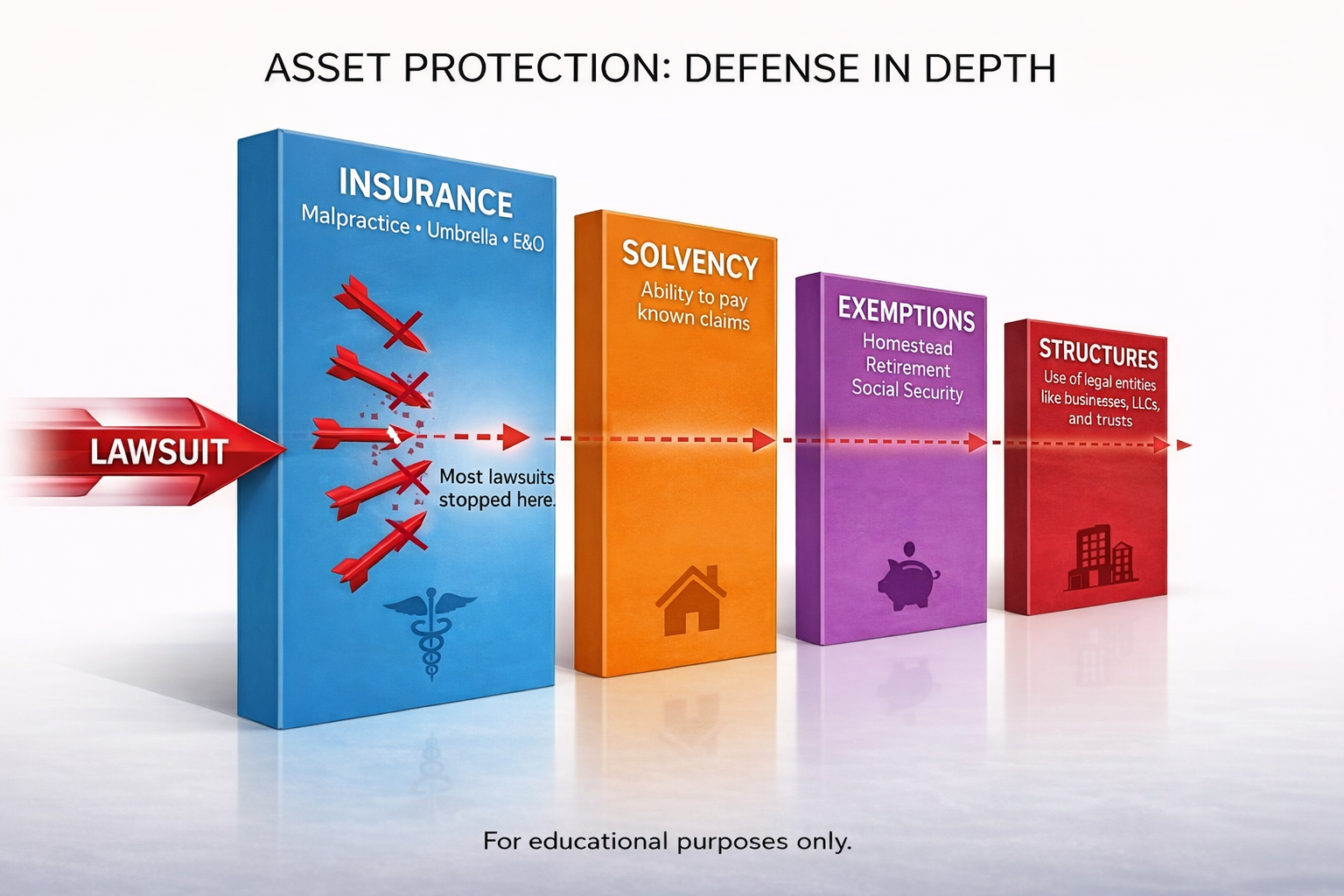
- Liability protection
Tax savings may benefit not only the person planning but also family members and society. Charitable planning benefits causes the client cares about. Depending on the circumstances, it can also serve business succession goals, reduce taxes, and produce other advantages.
Asset protection planning, which we also call liability planning, gives people the peace of mind because, if they were sued, it would be difficult, and in some cases impossible, for a creditor to reach their assets. How this works is fact specific, and there is never a guarantee. Even so, the benefit of knowing you have done asset protection planning can be considerable. If a lawsuit does come, it also helps in settlement negotiations, because the other side knows collection will be somewhere between difficult and impossible.
Legacy Planning
Legacy planning is responsible adult planning. It is entirely possible, though, to plan an estate without thinking much about what a legacy is, and to think instead about what it should not be.
What many people do not want is for their death or incapacity to cause immense harm and difficulty for the people they love. That harm takes different forms. One of them is an estate plan, or the lack of one, that destroys harmony within the family.
When people consider wealth, they think of financial assets and real estate, perhaps collectibles or other tangible personal property. For many, the most important form of wealth is none of that. It is social capital, the connection you have with your friends, and community, and most of all with family. The connectedness people have with their parents, siblings, cousins, and extended family, including in-laws, may be the best social capital there is.
Legacy planning can include business succession planning, which determines how a family business will pass on or be sold in a way that is equitable to other family members. Families with businesses are often vulnerable to losing their unity and cohesion. Building one thing while destroying another is a negative that is usually avoidable.
Taxation is a related issue. This includes the federal gift and estate tax regime as well as the income tax regime, which includes capital gains. How people organize their business entities, their real estate, their retirement accounts, and everything else they own affects how those assets are taxed. Understanding those consequences during the planning goes a long way toward legacy planning.
Legacy also includes how people view their role in contributing to their community, whether that means a religious institution, an educational institution, or another charitable endeavor. Charitable planning is intertwined with benefits to the donor, to the community, and to the donor's legacy.
Taxation is not merely a matter of someone who has money giving a portion of it to the government. Taxation is a form of social engineering. The tax code incentivizes and disincentivizes certain things. What charitable giving looks like, and does not look like, is influenced by what Congress thinks it should be. If you have a business entity, the code likewise speaks to which kinds of businesses get specific tax incentives and which do not.
Your values are your own and do not need to be dictated by the tax code. It is still useful to know what advantages the code provides. Where those advantages match your values, it helps to organize your assets in that direction.
The backbone of almost every estate plan is the revocable living trust.
The Revocable Living Trust
The revocable living trust has become a fundamental part of the estate plan. A typical plan includes:
- Trusts
- Wills
- Powers of attorney
- Advance health care directives
- Property agreements
- A variety of other documents, depending on the situation
The living trust is close to universal in California, and certainly for Orange County residents. A living trust is a form of contract. The agreement creates an arrangement among a grantor, a trustee, and a beneficiary. Other people can be involved as well, and we address those roles in other articles on this site.
Say Eeyore creates a revocable living trust. He is the grantor. He places his home, his bank account, and his brokerage account into the trust. A trustee is going to be in charge, and the trustee is Eeyore himself. He manages his own assets inside the trust as trustee, and he does it for the benefit of a beneficiary. That beneficiary is Eeyore. While Eeyore is alive and healthy, this arrangement works just fine.
Eeyore is doing this because he may pass away one day, or he may become incapacitated. In either case, the arrangement lets other people manage his affairs, either for his own benefit while he is alive or for the benefit of those he loves after he is gone.
If Eeyore passes away, his successor trustees take over. Those might be Tigger, Piglet, or Kanga. He may name the same people, or a different group, to determine his incapacity and manage his affairs if he becomes incapacitated.
For beneficiaries he can name those same people or someone else entirely, such as Winnie the Pooh or the Hundred-Acre Wood Preservation Foundation, or wherever else Eeyore wants his assets to go after he passes away.
Probate Avoidance
One of the main reasons to create a living trust is to avoid probate at death.
Probate happens when you need a dead person's signature to transfer property from one person to another. It is a court process, it is public, and it carries a range of fees. Estate administration outside of probate is substantially less expensive than administration through probate. In California, planning through a living trust is the norm. A living trust is not the only way to avoid probate, but for most Orange County families it is the most direct one.
Revocable Trusts vs. Irrevocable Trusts
A revocable living trust tends to be the backbone of an estate plan. People often wonder what an irrevocable trust is and how it differs. These are terms of art, and they are not as intuitive as they sound. You might assume that a revocable trust can be revoked and an irrevocable trust cannot.
A revocable trust can become irrevocable on the grantor's death or incapacity. That happens because the person who created it set it up so that certain things would happen at death or incapacity.
Many people create irrevocable trusts for gift and estate tax planning, Medi-Cal planning, asset protection, or special needs. In gift and estate tax planning, rules on estate inclusion can pull an irrevocable trust back into the individual's taxable estate. Sometimes that is exactly what the client wants. Other times it is a disaster, because it produces a massive tax bill.
Here are a few examples of why people create irrevocable trusts.
Special Needs Trusts
Severus has Down syndrome and receives a wide range of public benefits. His uncle, Albus, wants to improve Severus's quality of life over the long term. He should not give a gift to Severus directly. Instead, he creates a special needs trust for Severus's benefit. This is a gift. Albus is not going to get any of it back. He will not necessarily even control it. It is gone, gifted in a particular way for the benefit of Severus.
Split Interest Trusts
Neville and his wife, Luna, own shares in a publicly traded company that have appreciated from an initial investment of $10,000 to $5 million. They create a split interest trust known as a charitable remainder unitrust. They keep a unitrust interest, which pays them 6% of the value of the trust, revalued each year, for the rest of their joint lives.
They donate the stock, worth $5 million, to the trust. The shares can then be sold without an immediate capital gains tax. Inside the charitable remainder trust, securities can be bought and sold in an environment similar to an IRA or a 401(k). Their goal is to keep the money growing at a rate greater than what they withdraw.
Neville and Luna have wide flexibility in how they invest. When they both die, the balance of the trust goes to the charity of their choice. Their attorney gave them an illustration showing that if they invest and withdraw the way they expect to, at a realistic rate of return, they may do better than if they gave nothing to charity at all. They may also use some of the money they receive to buy a life insurance policy that would replace the $5 million if they both die sooner than expected.
Split interest trusts work in a wide range of circumstances,and not all of them are charitable.
Protective Trusts
Rubeus creates a trust for his daughter, Minerva. His instinct was to give the money to her outright, but he is concerned that Minerva may be sued, that her husband may be sued, that she might divorce, or that any number of other financial calamities may come about. He wants the assets he is giving to serve not only his daughter but his future progeny through Minerva. He also wants the gift to be exempt from the generation skipping transfer tax.
Planning for Death
Almost every kind of planning contemplates what happens when the testator, the person making the plan, passes away. It also protects against eventualities that may or may not occur.
One thing to understand about planning for death is that you are planning for something that will happen at an indeterminate point in the future. You do not know the circumstances of the people you will leave behind, exactly who you will leave behind, or what their lives will look like.
You know what the world is like right now. You have some idea of what your children are like, if you have any, what your spouse is like, if you have one, and what condition your business or your employment is in.
One of the most important things an Orange County estate planning attorney can do is walk you through the concerns that commonly arise in estates. Some you may not care about. Others you may care about a great deal. Your attorney needs to understand which is which.
Some people are very worried about a spouse remarrying. Others are not. Some believe they should have a great deal of influence over how their money is spent long after they are gone. Others do not care about that at all and plan from a perspective of harm reduction rather than micromanaging the future. Many find a balance in between.
Planning for Incapacity
Incapacity planning is one of the most important parts of any estate plan.
Ahab is an accomplished man who raised a family, built businesses, and helped everyone in his community. Starting in his late sixties, though, he became vulnerable to complete strangers. One of his children, Ishmael, noticed that his father had "invested" $100,000 with a man named Dick in an AI and crypto startup that made no sense at all. Ishmael looked Dick up online and found a convicted criminal and a known scammer.
Ahab thinks Dick is the most amazing person in the world and will not believe Ishmael when he says Dick is ripping him off. Ishmael believes his father has lost executive function and is no longer capable of making sound financial decisions. He has noticed several other signs in his conversations with Ahab that led him to that conclusion.
Ishmael can take his father to court and seek a conservatorship. It is usually better to have a system in place that protects Ahab's dignity and privacy. The rest of the world does not need to know that Ahab was ripped off by Dick. It does not need to know about whatever other instances there were where Ahab was slipping.
In a well-built estate plan, this is addressed through the living trust, the power of attorney, and potentially other documents depending on Ahab's circumstances.
Health Care Decisions
Most people do not think of health care decisions as part of an estate plan. This is one of those responsible adult things that everyone should do.
Alice has an uneasy relationship with her mother, the Queen of Hearts. She wants to make sure her mother has no say in her health care decisions. She loves her mother. Her mother is simply given to emotional tantrums, and Alice finds her reasoning less than sound. Alice decides that her best friend, the Mad Hatter, is the better choice. If the Mad Hatter is not available, she would prefer the Cheshire Cat to make health care decisions for her when she cannot make them herself. The people she names can also review her health care information, which is otherwise private under HIPAA and, in California, the Confidentiality of Medical Information Act.
Estate Litigation and How to Avoid It
Beyond taxes and hurt feelings, one of the biggest risks in estate planning is litigation. Litigation can wipe out an estate entirely. There is a risk of probate when you do not plan through a living trust, and probate courts stay busy with estate litigation. Holding assets in a living trust, or even in irrevocable trusts, does not prevent litigation. Neither does asking your survivors not to litigate.
Avoiding litigation requires the estate planning attorney to have some sensitivity to the family's situation and an awareness of the patterns that lead to disputes. When a family leader, a patriarch or matriarch, is at the center of the planning, their eventual absence shifts the unity and social capital of the entire household. Families are immensely complex, and trauma can run deep and last for decades, often undetected by parents and grandparents.
Some family situations are train wrecks waiting to happen. This is most visible in blended families and in substantial family businesses where some family members work in the business and others do not.
Add to that the issues raised by international assets, artwork, and family heirlooms. Families tend to become more complicated overtime. There are marriages, in-laws, social slights that nobody let go of, like the sister-in-law who was not invited to a daughter's birthday party three years ago. There are people seemingly removed from the family by a degree or two whose opinions suddenly seem to matter.
Even with all of this, it is possible to build a well-thought-out and sophisticated estate plan designed to avoid litigation. People want to be respected, and they want to be heard. There need to be ways to resolve things amicably before anyone files anything, and much of that can be built into the plan itself.
Talk to an Orange County Estate Planning Attorney
Estate planning is one of the most important things an individual or a married couple can do for their family. It is a substantial investment of time and emotion, and doing it right is well worth it.
Our office is in Costa Mesa, minutes from Newport Beach and Irvine, and we work with clients throughout Orange County, including Tustin and the surrounding communities.
Subscribe to our email list to learn more about how we advise our clients in manifesting the best of their values when planning for the future.
Ahmed Shaikh is a dual California Certified Specialist in Taxation Law as well as in Estate Planning, Trust and Probate Law and has practiced law in California since 2000. He is a former Chair of the Orange County Bar Association Trusts and Estates Section and a Partner at Bohm, Wildish and Matsen LLP.
.jpg)